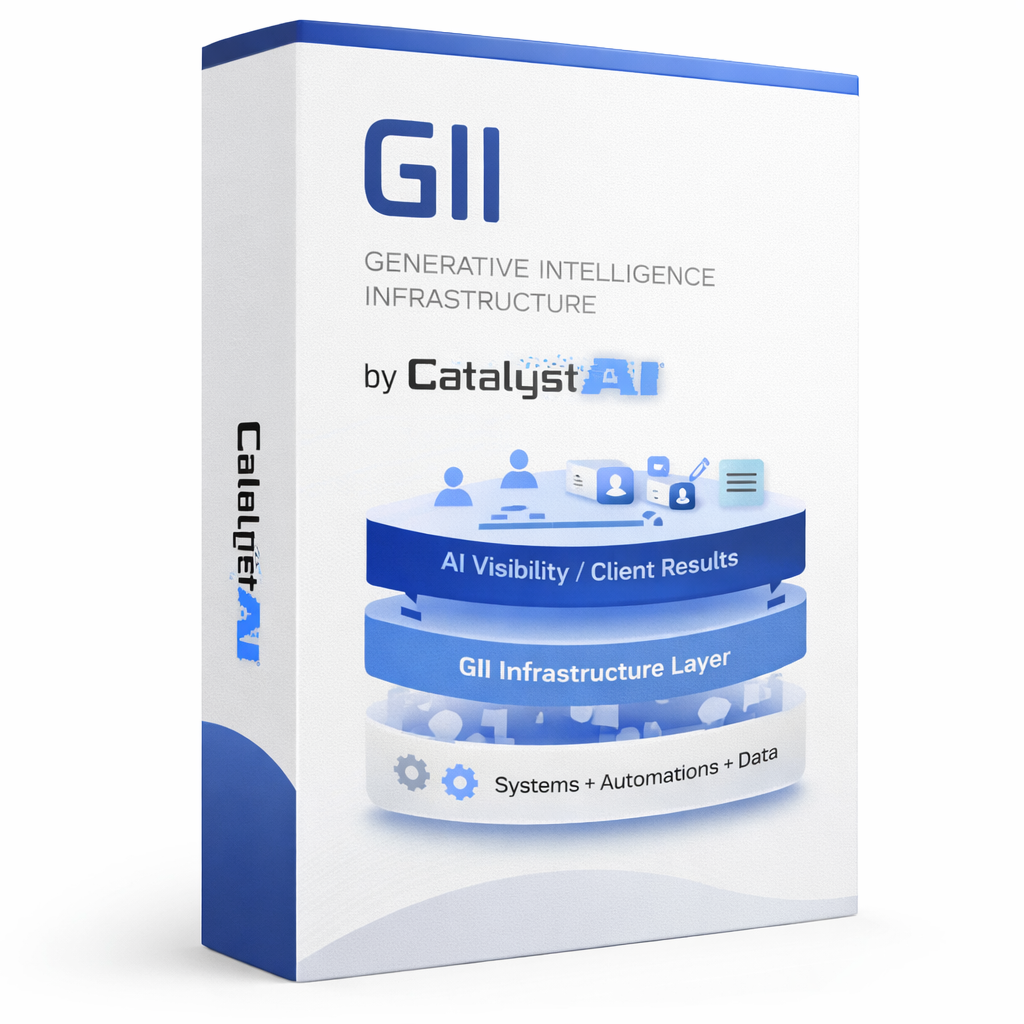
Generative Intelligence Infrastructure
Launch a Real AI Infrastructure Business in 7 days
Without building the offer, the system, or the backend yourself.
CLICK BELOW TO WATCH FIRST!
A complete, prebuilt Generative Intelligence Infrastructure service—with everything already in place so you can focus on one thing: selling it.
In simple terms: this is how businesses get recognized, trusted, and recommended by Ai systems. You'll be the one who delivers that.
The problem isn't awareness. It's traction.
Most people trying to build an AI service business have spent months watching video's, buying courses, and experimenting with tools.
And after all of it— they still don't have a defined offer, a delivery system, or a single paying client.
Not because they aren't capable.
Because they're trying to build from scratch something that already exist.
Months pass. nothing launches. nothing sells.
That's the gap this system closes.
This is not a course
It's not theory or a collection of tools.
It's a complete Generative Intelligence Infrastructure business you can learn in a week and start selling immediately.
The offer is defined. The backend is built. The delivery model is there. The training is inside the system.
You are not assembling pieces. You are stepping into something complete.
WHO BUILT THIS—and why it matters
I've spent 28 years...
building real businesses.
A water purification company that exited for $30 Million. A award winning production company that did 10,000+ people concerts. A members-only nightclub called Sugarkube—6500 paying members every month. Awards and Mentions like:
Best Sound
Best Nightclub
People's Choice Award
Newspaper Headlines

I'm not an influencer. I don't sell theory.
I'm a builder who spent the last 4 years developing the methodology for how AI systems build trust relationships with named entities— and turned that into a sellable service that businesses actually need right now.
I built this system for myself. Then I realized the bigger opportunity was handing it to operators who are ready to take it to their market.
That's what Catalyst AI is.
The Shift You are Selling Into
AI Doesn't Index
Ai systems don't index like Google does.
They build trust relationships with named entities—businesses, people, and organizations.. Those entities gain authority by appearing consistently across structured, trusted data sources.
Businesses that are properly structured inside that ecosystem get cited, recommended, and discovered by AI.
Business that aren't—don't exist to AI at all.
This is not an experiment. This is already how AI systems operate.
Most businesses have no idea this is happening. Most agencies have no idea how to address it.
You Will.

What you're selling.
Generative infrustructure service positions businesses to be recognized, trusted, and recommended by ai system.
it's a real service
a needed service
Little competition
And you'll have everything you need to deliver it from day one
What's inside the system.
The Infrustructure
A fully configured Go High Level subaccount—pipeline, workflows, automations, and email sequences
Webflow client delivery template—professional grade , customizable for any vertical
AI employee framework
Endless lead generative source system
The Methodology
Complete GII framework training— the system that powers the service
Entity infrastructure training—how to build client authority through critical database systems.
GII Command Modules Suite— three pre-built operating systems that turn AI systems into your dedicated business partner
AI employee that actually has a mouse and keyboard—actually builds inside systems.
The Sales System
Warm market sales scripts—who to contact, what to say, how to close
LEADGEN Engine— endless verified leads from every professional services industry
Email outreach sequences ready to deploy
My most effective emails
The Training
10 core modules inside a private membership
5 bonus modules including: Canva branding, AI marketing Copy, and dream client avatar builder.
How to actually use AI to operate and grow the entire business
Two live implementation calls in your first month.
Your service ladder from day one

GII Retainer
$500-$5,000 per month per client

Entity Infrastructure Setup
$500 One Time Per Client

Premium Webflow Build
$2,000-$5,000 one-time per client
One client can return your entire investment
Three clients and you're profitable before month end.
Start with who you know already

Your industry

Friends industries
Family industries

Industries you are knowledgeable in

Adjacent Industries
Your first client is probably already in your phone.
Start with your warm market— people in your existing industry who already trust you.
You don't need cold outreach to close your first client.
You need a conversation and a clear offer.
The LeadGen Engine is there for when you're ready to scale beyond your warm market.
But your first dollar comes from a conversation you could have today.
How this is different
Every other offer in this space sells you information
This sells you a business
Most courses give you knowledge without a path to revenue. This gives you a complete operating system— the service, the delivery model, the infrastructure, and the sales system—so the only variable is how fast you go out and sell.
You're not learning about AI services.
You're running one.
What this requires from you
This is not passive.
You will need to learn the system, do the outreach, and engage in selling.
What this removes is the need to design any of it from scratch.
If you want a lottery ticket—this isn't it.
If you want a structured, executable path into AI service market with a defined offer and a built system behind it —this is exactly that.
The market is moving. The window is open.
The only question is whether you're going to be the person selling AI infrastructure services along side me, or the person buying them from someone else.
The offer
$1497—One Time
CatalystAI
Complete system access, Full training. Loaded subaccount. Webflow template. GII command Modules suite. LeadGen Engine. Warm market sales script. Two implementation calls in month one.
100% risk free - 30 day money back guarantee

$197 /mo after
keep the infrastructure active
Licensing on my GII
GHL Account + all automations
AI Employee framework (token based)
Full training
Total value: $5699
Today Just $1497
This isn't for everyone
If you are still exploring— this isn't right for you.
Come back when you are ready to operate.
If youve been watching the market shift and you are ready to stop watching and start selling—this is your path in.
The system is built. the service is real. The market is ready.
The only variable is whether you step into it.
Copyrights 2026 | CatalystAI ™ | A Brainkandy Media Company |Terms & Conditions